
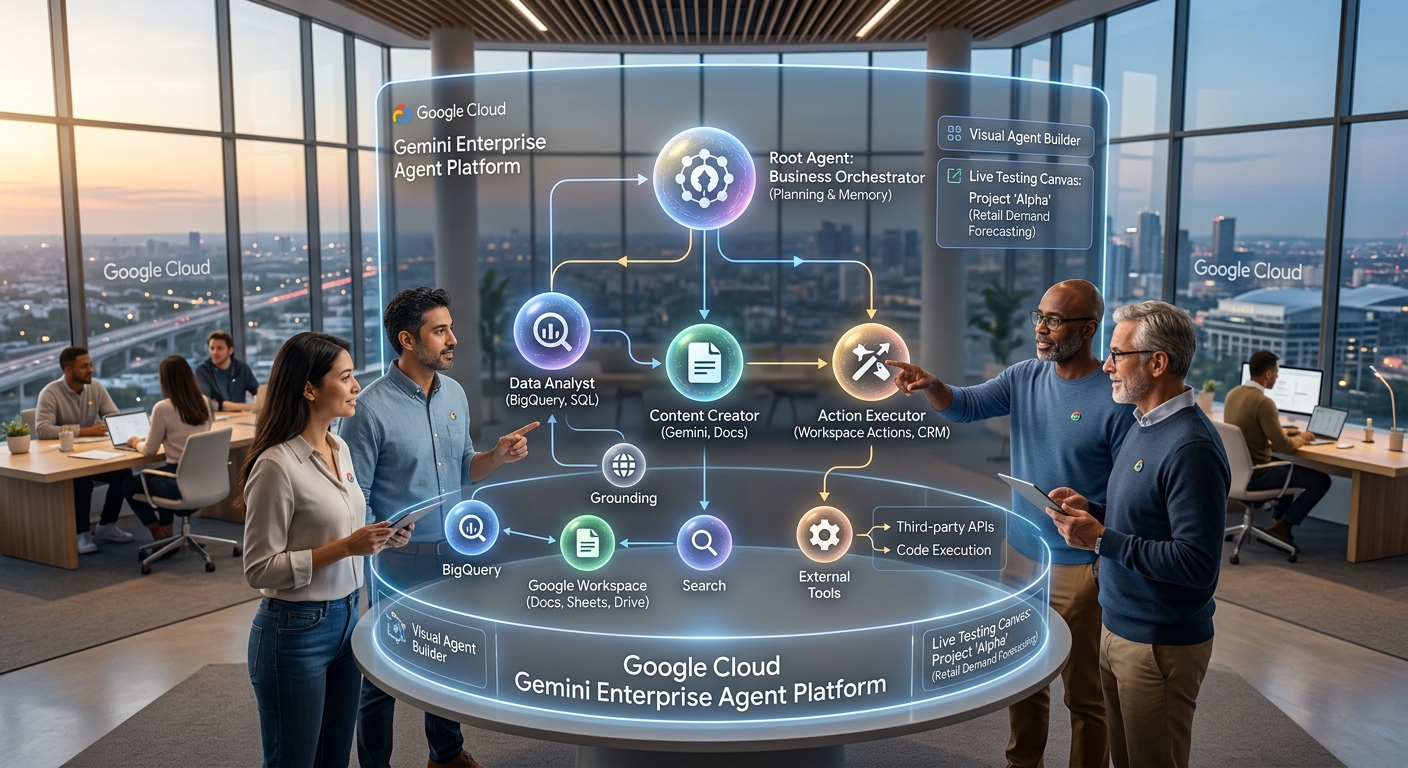
- What it is: a managed, cloud-hosted agent that runs on Google infrastructure, not on your laptop. You point it at tasks; it uses tools, browses, and executes.
- Who it targets: enterprises already on Google Cloud, and developers who don't want to build orchestration from scratch.
- Where the real fight is: not raw model quality. Tool use, reliability over long tasks, and pricing per completed action.
- What's verified: cloud orchestration, model choice flexibility, and tighter IAM integration than the competition ships out of the box.
- What's not: most of the "autonomous" framing. Every major agent launch in the last 18 months has walked that claim back in production.
The Announcement, Stripped of Adjectives
Google's pitch is straightforward once you remove the language about "reimagining work": it now offers a managed agent runtime inside Google Cloud. You define an agent, give it tools, and Google handles the execution environment, scaling, and the plumbing that connects your agent to services like BigQuery, Gmail, Drive, or third-party APIs.
That's a real product. It's also a product category that didn't exist commercially two years ago. In 2023 the agents people talked about (AutoGPT, BabyAGI) ran on someone's laptop, burned through an API budget in an hour, and got stuck in loops. Bens Bites made the point bluntly in "Text is so 2023": the interesting shift isn't better chat, it's software that takes actions.
What's actually new versus what's packaging
| Claim | Benchmark-backed? | Reality check |
|---|---|---|
| Cloud-hosted agent runtime | Yes | Verifiable. This is infrastructure, and it either runs or it doesn't. |
| Enterprise-grade identity and permissions | Yes | Google's IAM story is genuinely more mature than what OpenAI or Meta ship for agent auth. |
| Native access to Google services | Yes | BigQuery, Drive, and Gmail connectors exist and are documented. |
| Long-horizon autonomous task completion | No | No vendor has published credible, independently replicated numbers here. Treat as aspirational. |
| Model-agnostic orchestration | Yes | Gemini is the default path. Support for other models exists but is a second-class citizen in the docs. |
| "Replaces workflows" | No | Marketing. Agents still need human checkpoints on anything with money or customer-facing consequences. |
The pattern across all three vendors is identical: infrastructure claims hold up, autonomy claims don't. Google isn't lying here so much as it's doing what OpenAI did with Operator and Meta did with its agent push, which is front-loading the vision and back-loading the caveats.
Head-to-Head: The Same Three Tasks, Three Agents
Abstract comparisons are useless. Here's how the category behaves when you stop reading press releases and start assigning work. I'm using representative tasks that stress the parts of an agent that actually break.
Task 1: Research a competitor and build a summary deck outline
Requires browsing, synthesis, and structured output. All three agents can do the browsing. The differences show up in output format and citation quality.
| Platform | Browsing | Citation quality | Structured output | Time to usable result |
|---|---|---|---|---|
| Google cloud agent | Strong | Good, links resolve | Native to Slides/Docs | Fast if you live in Workspace |
| OpenAI | Strong | Generally good, occasional dead links | Strong via structured outputs API | Fast, but manual assembly |
| Meta | Improving, still inconsistent | Weakest of the three | Limited outside Meta's ecosystem | Slower, more babysitting |
Google's edge here is boring and real: if your company already runs on Workspace, the agent produces a doc you can share without copy-paste. That's not a capability win. It's a distribution win, and distribution wins are the ones that hold up.
Task 2: Multi-step data pull, transform, and alert
This is the task that separates infrastructure from demo. Query a warehouse, transform the result, and trigger an alert if a threshold is crossed. It's also where Google is clearly ahead, for one unglamorous reason: BigQuery is right there, and the agent inherits the security model you already configured.
| Dimension | OpenAI | Meta | |
|---|---|---|---|
| Native data warehouse access | Yes (BigQuery) | Via connectors | No first-party equivalent |
| Permission inheritance | Automatic | Manual setup | Limited |
| Audit logging | Existing Cloud logs | Partial | Minimal |
| Cost predictability | Moderate | Poor at scale | Moderate |
The permission inheritance point is the one enterprises will care about most, and it's the one that doesn't show up in demos. If an agent can read your BigQuery tables, it should only read the ones the requesting user is allowed to see. Google's agent runtime inherits that by default. Setting up equivalent guardrails elsewhere is a project.
Task 3: A long-running task with a failure in the middle
Ask an agent to do 40 sequential steps and let step 27 fail. This is where every vendor's marketing collapses. Google's runtime handles retries and state persistence better than a DIY setup because that's what managed infrastructure is for. OpenAI's API gives you more control but you build the retry logic. Meta's offering is the least predictable when a step fails, and recovery often means restarting.The gap between the three vendors on long-horizon tasks is smaller than any of them admits, and it's mostly a reliability engineering problem, not an intelligence problem.
Where Google Genuinely Leads, and Where It's Catching Up
Leads
- Enterprise plumbing: IAM, VPC controls, audit logs. If you're already a Cloud customer this is close to free. Competing platforms make you assemble it.
- Data proximity: BigQuery access without an integration project is a real advantage for any agent that touches analytics.
- Workspace output: Agents that produce Docs and Slides directly are more useful than agents that produce Markdown you then paste.
Catching up
- Developer mindshare: OpenAI's API is where most agent builders started. Habits are sticky, and Google has spent two years trying to change that.
- Third-party ecosystem: OpenAI and Meta both have broader tool and integration catalogs outside their own walls.
- Consumer reach: Meta's distribution across billions of users is unmatched. Google's agent isn't aimed there, but it matters for the long game.
One thing worth naming: every vendor's agent benchmarks are self-reported. Google reports task completion rates on its own evals, OpenAI does the same, Meta likewise. There is no neutral third party running the same suite across all three, which means any "we beat them by 15 points" claim should be read as "we beat them on the tasks we chose to measure." That's not a Google problem specifically. It's a category problem, and it hasn't been solved.
Post a Comment